In reality, there’s a difference between “Affordable Housing,” “workforce housing,” and “affordable housing.”
“Affordable Housing” consists of rental units targeting households earning 60% of Area Median Income (AMI) or less and is typically financed with scarce government resources.
“workforce housing” consists of renters and owners earning between 60% and 120% of AMI and is typically financed with a mix of government and private financing.
“affordable housing” refers to housing that costs renters and owners 30% or less of their income. That said, “Affordable Housing” can be unaffordable. Same goes for “workforce housing.”
That said, there’s a clear distinction between “Affordable Housing” and “workforce housing” – the 60% of AMI line.
Just yesterday I had the following discussion with my civil engineer regarding a proposed $35mm workforce housing development to be financed with tax-exempt bonds – a typical day in the life of a developer:
Engineer: “The city wants us to obtain an easement for this 6-square foot piece of private ground to install these offsite stormwater improvements.”
Me: “Ok. But it’s a public improvement, why should I be the one to obtain the easement? That neighbor will likely ignore me. After all, I’m a for-profit developer intending to build apartments near his single family home.”
Engineer: “The city will step in only after you have made an attempt to obtain the easement, but failed.”
Me: “Ok. What will it cost and how much time will it take? Will it hold up my permits? I cannot close on my bond financing without them.”
Engineer: “The easement will probably cost about $2,000. Really not much at all. The city will issue your permits prior to obtaining the easement, but won’t let you begin construction until the easement is obtained. It’ll probably take 6 months to obtain the easement.”
Me: “What you described isn’t a $2,000 problem, it’s a $1,052,000 problem.”
Engineer: “How’s that?”
Me: “At closing, $35 million will get funded into a Trustee account earning 6% (or more) annual interest. Our construction start will get pushed back 6 months which will cost us $1,050,000 in interest, plus the $2,000 to acquire the easement. Does the city not understand the time value of money?”
Engineer: “Wow. I had no idea.”
From the piece:
“First and foremost, local officials should take a hard look at their internal regulatory and permitting requirements. In real-estate development, time is money. Regulatory and permitting processes often unnecessarily add to this burden.”
Don’t confuse PRICING and INCOME TARGETING when discussing affordability. Rents for folks earning 80% of Area Median Income (AMI) can be set affordably while rents for folks earning 50% of AMI can be set unaffordably.
What is found in this piece is actually an appeal to change income targeting, not an appeal to make this project more affordable.
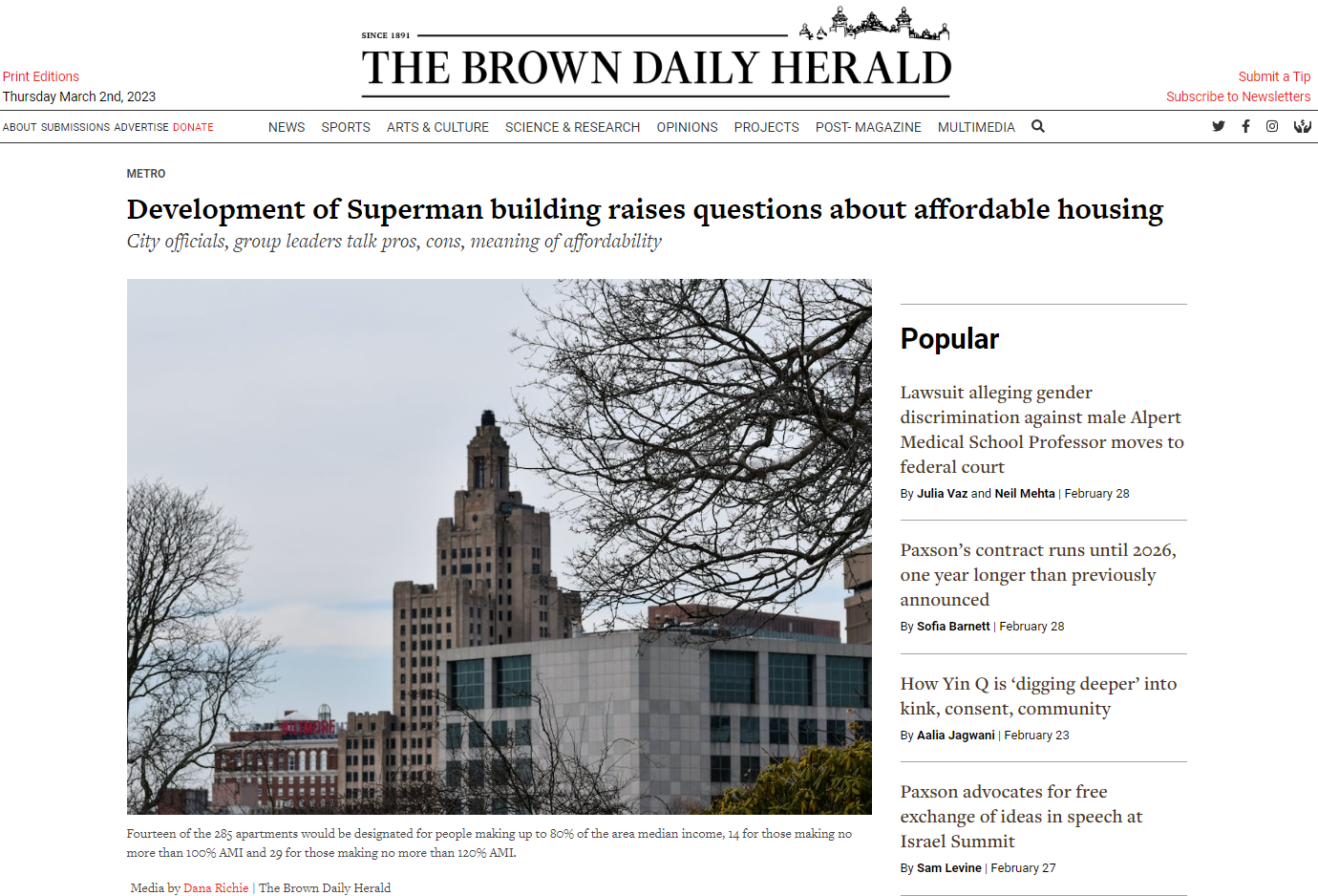
From the piece:
“Though these units have been designated as affordable, ‘only even a small number of those are at the 80% (AMI) level, and 80% is the highest end of what you can really call affordable housing,’ said Peter Asen ’04, deputy director of development and governmental affairs for the Providence Housing Authority.”
Affordable housing is often relegated to marginal development sites, frequently with environmental issues, adding to the cost and time associated with development. Indeed, the developer and the future residents of these projects will ultimately pay for remediation, which is no way of incentivizing much-needed development.
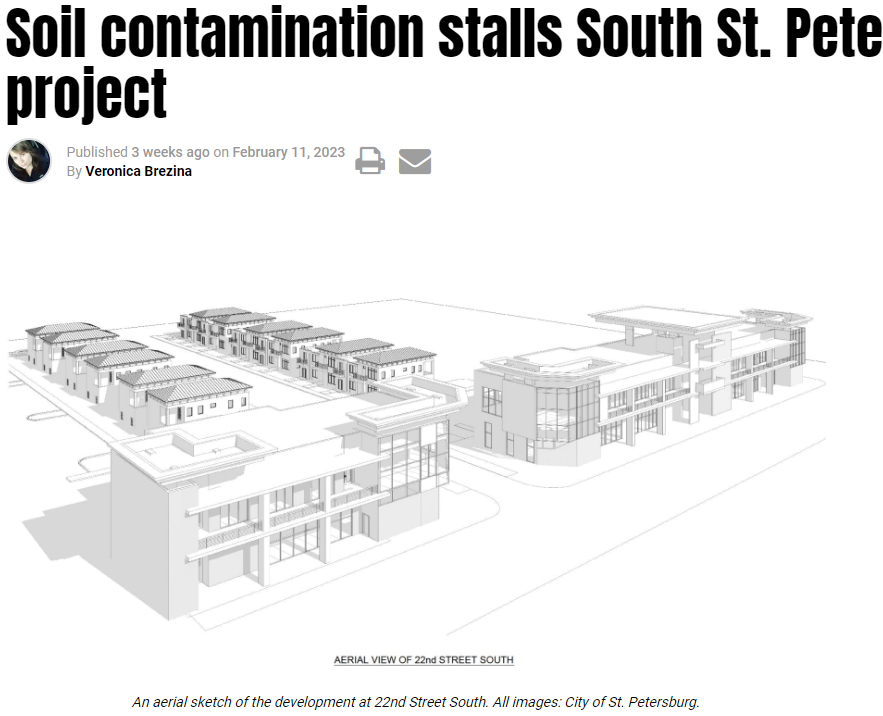
From the piece:
“During a Feb. 7 Citizen Advisory Committee South St. Petersburg Community Redevelopment Area (CRA) meeting, City Architect Raul Quintana informed the committee members the soil contamination was discovered through sampling, and they are now working with the DEP (Department of Environmental Protection) on the removal process. Soil contamination is commonly found at industrial sites.
A dry-cleaning business and metalworks building once operated at the location.”
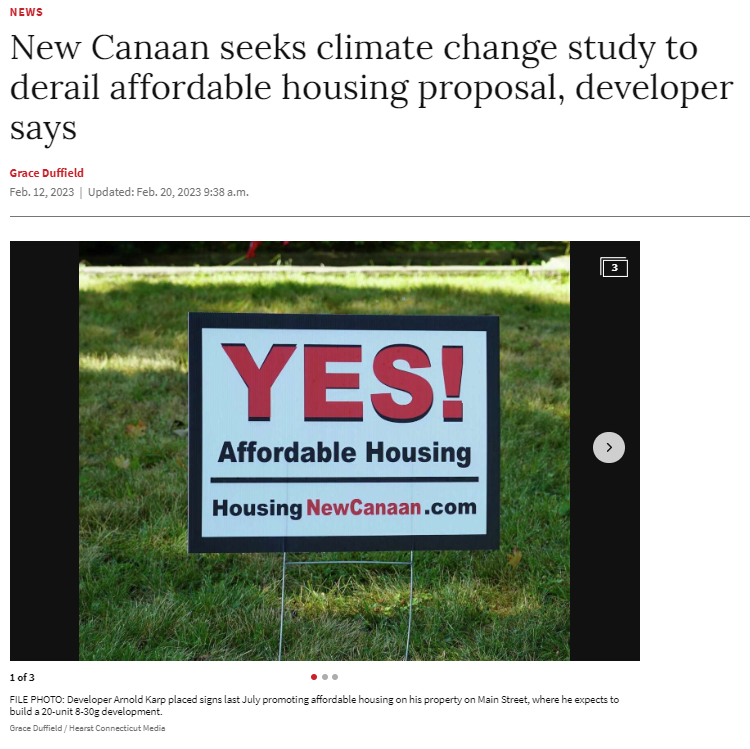
This is how they do it. Affluent towns like New Canaan use endless “studies” to discourage affordable housing development. And they often create “committees” purportedly to produce more affordable housing, but in reality to kill any new proposals.
I’ve even seen cities purposely rezone low-lying and swampy areas for affordable housing, knowing they will never be buildable. That way, they can look good on paper (zoning map) while systematically discriminating against lower income families.
From the piece:
“In a letter to the town, Karp’s attorney Christopher Smith argued the WPCA is trying to prevent more affordable housing from being developed in New Canaan and the delay has nothing to do with global warming.”
The city has the tools for fast-track approvals and the issuance of bonds. Private companies like mine can bring the technical expertise to design and manage these developments for cities who choose this approach.
From the piece:
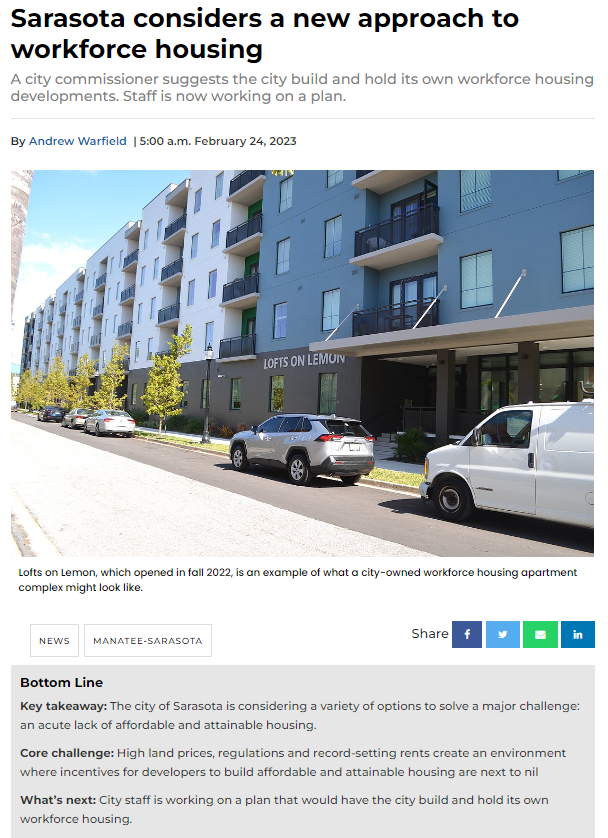
“City staff is working on a plan that would have the city build and hold its own workforce housing.”
There’s the old adage: “You always get less of what you tax.” That’s why an affordable housing tax on developers is such a bad idea.
In reality, the creation of workforce housing should be linked to job creation. It should be treated just like any other public improvement.
For example, a large manufacturer comes to town and the city determines what new infrastructure will be needed to support the new facility. The city issues bonds to extend water, sewer, gas, and electricity and contracts the construction of these new utilities.
While they’re at it, why not evaluate the manufacturer’s housing need and issue bonds for it, too? This, along with fast-tracking the zoning approvals for a sufficient number of workforce housing units, would be a good aporoach.
Cities have all of these tools at their disposal. Proactively using them instead of doing the bidding of the short-sighted NIMBY crowd is the solution to our workforce housing problem.
From the piece:
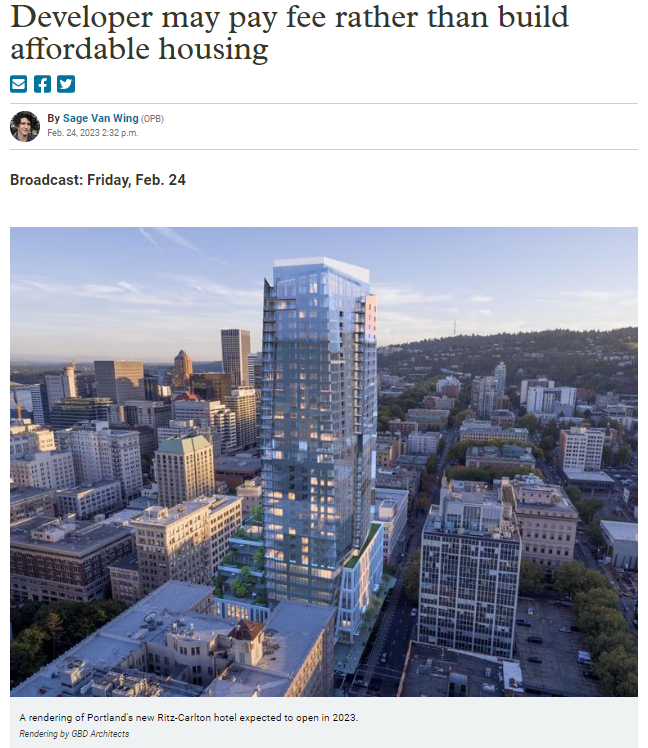
“Starting in 2017, all new apartment buildings built in Portland with more than 20 units must dedicate a portion of their units to low and moderate-income housing. But some developers are choosing to pay a penalty instead of creating affordable housing.”
Read this headline. Think about what it’s saying. It puts the words “affordable” (i.e., inexpensive and plentiful) in the same sentence with “lottery” (i.e., scarce).
Remember when 72-inch flat-screen TVs were a $10,000 luxury? Now we can select from scores of competing brands for a small fraction of that cost.
How did this happen? Was it the result of a lottery? Government regulation? Limits on new flat-screen TV production and ownership?
No. It was the result of competition.
Let the marketplace work. Deregulate the production of housing and let developers like me reach renters and buyers previously unreached.
From the piece:
“The affordable housing lottery has launched for 200 Montague Street, a 20-story residential building in Brooklyn Heights, Brooklyn. Designed by Beyer Blinder Belle and developed by Aurora Capital Partners, the structure yields 121 residences. Available on NYC Housing Connect are 38 units for residents at 80 to 130 percent of the area median income (AMI), ranging in eligible income from $54,960 to $215,1500.”