Net-Zero Affordable Housing

The backbone of my company’s workforce housing development initiative is energy efficiency. In 2014, we constructed a two-phase project to explore the benefits of building with structural insulated panels as opposed to traditional stick-built framing.

We discovered that by spending as little as $5,000/unit more on carefully-selected components, we could attract up to $30,000/unit of additional capital to finance our projects. With construction costs of $150,000/unit, this $25,000 net benefit goes a long way towards keeping our projects affordable.

What to do with $25,000/unit? We decided to target the hard-to-reach workforce housing market. We engineered a family of 3-story garden apartment buildings and have several workforce housing projects underway at this time.

What we discovered is totally counterintuitive. We actually closed a $25,000/unit funding gap by spending MORE on construction, not less. Unfortunately, most developers, contractors, architects, and engineers have not yet come to understand the economics behind this. But they will one day – I am certain of that.

From the piece:

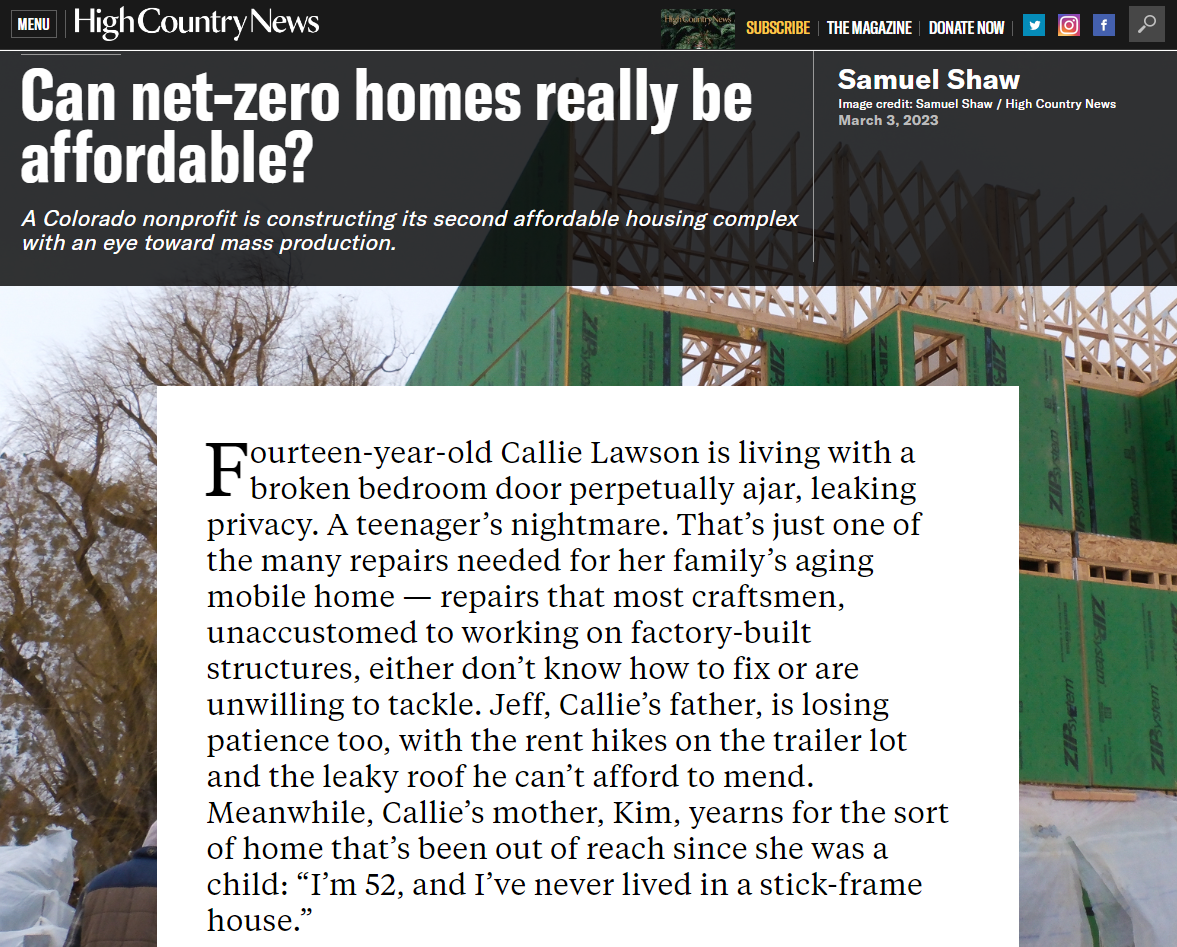
“The local branch of Habitat for Humanity is constructing Wapiti Commons, a 20-unit development slated for completion next summer. The project boasts units that are not only affordable, they’re also net-zero, meaning the development will produce as much energy with its solar panels as its efficient appliances consume, making utility bills cheaper. This is no custom-built one-off, but part of Habitat’s plan to show that sustainability can be standard, not just a luxury add-on. Habitat sees Wapiti and its sister site, Basalt Vista, as templates of what’s to come.”

A link to the piece can be found here
Accessory Dwelling Units

One of the problems with relying on single family accessory units to address our affordable housing crisis is the fact that professional management and providing appropriate supportive services need to be considered as well.

Many homeowners and property managers are not qualified to do this.

From the piece:

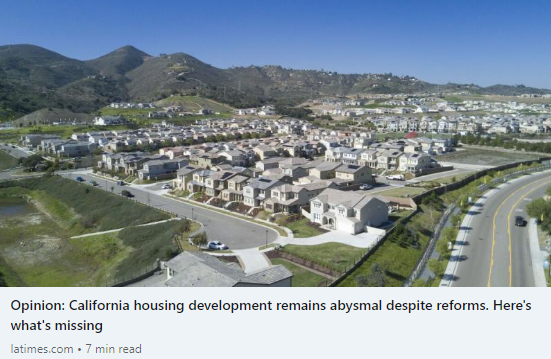
“If California actually wants housing to be inexpensively produced, it must enable large-scale production of housing by private firms that have strong incentives to cut costs. Whether politicians like it or not, housing production is indeed governed by the laws of supply and demand.”

A link to the piece is found here

Rent to Own Program for Low-Income Seniors

This is a great program.

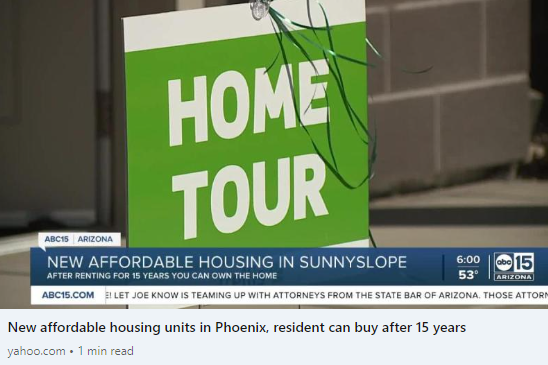
My development team and I built a similar project in Kansas City several years ago. Residents could purchase their units in 15 years at up to a 45% discount. We targeted 55+ renters who, in 15 years, will have the opportunity to purchase their duplex unit and have as much as $150,000 of equity already built into their home.

What we put together is more than a homeownership program – it’s an estate planning tool for lower income seniors.

From the piece:

“A new affordable housing unit is going up in Phoenix where those who qualify will be able to buy the homes. A ribbon cutting ceremony was held Wednesday for new housing units.”

A link to the piece is found here

The Effect of Government Regulations on Construction Costs

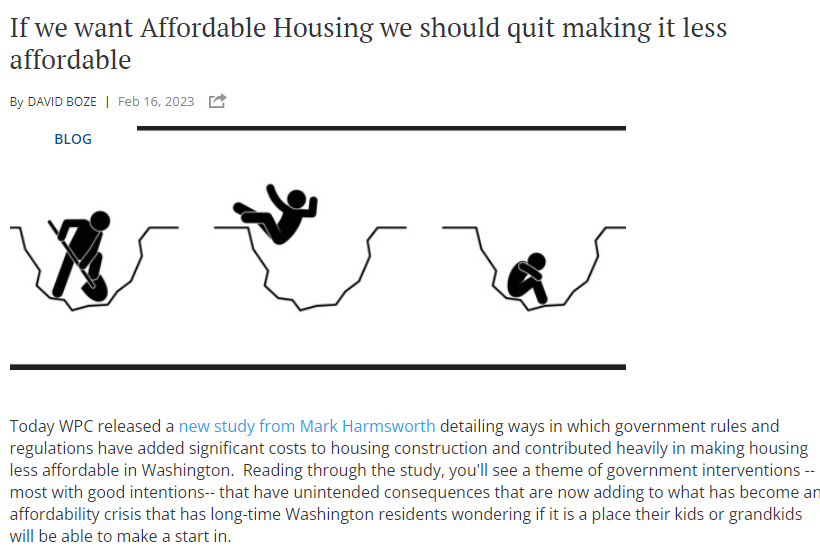
A recent study conducted by the Washington Policy Center found that as much as 24 percent of housing price increases may be attributed to the government policy. Indeed, the study found that state and local laws, permitting, building restrictions and regulations add on average $144,000 to the cost to construct a new, median priced home.

Reminds me of the old saying “No society in the history of the world taxed and/or regulated itself into prosperity.”

A link to the piece is found here

Rent Control Revisited

This is a great example of how rent control actually hurts the very people it is intended to help. Fact is, rent control is actually the enemy of affordability.

From the piece:

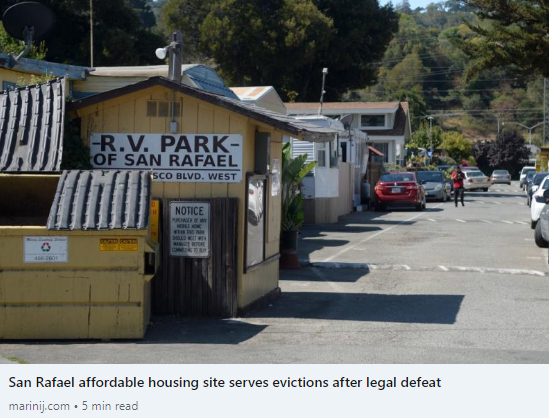
“Nearly all residents of the R.V. Park of San Rafael received eviction notices this week after the property owner lost a rent battle [with the residents] in the 9th U.S. Circuit Court of Appeals.”

A link to the piece is found here

The Root of the Workforce Housing Problem

Cities that spend millions of dollars on technical schools and incentives to attract employers while simultaneously denying workforce housing proposals are essentially saying “Learn here, take your skills elsewhere. Work here, spend your paychecks elsewhere.”

From the piece:

“Millions of dollars for workforce training will go to naught if we don’t have enough housing where workers can afford to live,” he said. “In addition to increasing investments in affordable housing, our budget proposes an additional $200 million for workforce housing.”

A link to the piece is found here

The difference between “Affordable Housing” and “affordable housing”

In reality, there’s a difference between “Affordable Housing,” “workforce housing,” and “affordable housing.”

“Affordable Housing” consists of rental units targeting households earning 60% of Area Median Income (AMI) or less and is typically financed with scarce government resources.

“workforce housing” consists of renters and owners earning between 60% and 120% of AMI and is typically financed with a mix of government and private financing.

“affordable housing” refers to housing that costs renters and owners 30% or less of their income. That said, “Affordable Housing” can be unaffordable. Same goes for “workforce housing.”

That said, there’s a clear distinction between “Affordable Housing” and “workforce housing” – the 60% of AMI line.

A link to the piece is found here.

Workforce Housing: A Wise Investment Choice

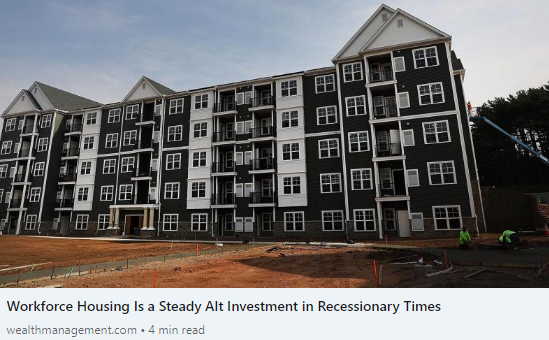
“Indeed, certain types of investment real estate—especially multifamily housing—tend to perform better during downturns. And within the category of multifamily housing, workforce housing is fast becoming a wise investment choice for high-net-worth investors during volatile economic periods.”

A link to the piece can be found here.

Cities: The Largest Employers of America’s Workforce

Cities themselves are one of the biggest employers of people seeking workforce housing. Although they have all of the necessary tools (Planning & Zoning, Economic Development, Community Development, Housing Authority) they typically lack the technical expertise to address their growing workforce housing problems. Indeed, I have seen cities where as many as 70% of their employees are forced to commute to work each day because they cannot afford to live in the very town they serve.

My company offers the technical expertise to help cities address this growing problem. 

From the piece:

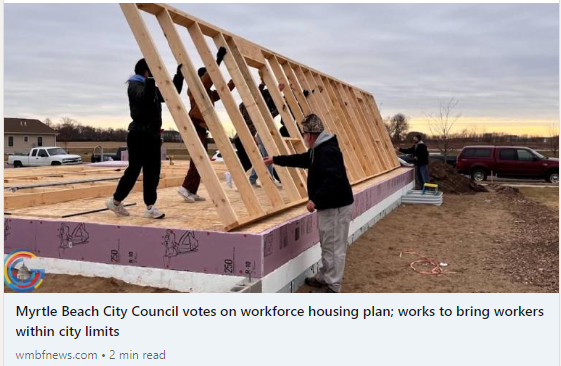
“The Myrtle Beach City Council voted in favor of two resolutions on Tuesday that they hope will help solve the lack of housing options for city employees.”

A link to the piece can be found here.

The Real Cost of Delays

Just yesterday I had the following discussion with my civil engineer regarding a proposed $35mm workforce housing development to be financed with tax-exempt bonds – a typical day in the life of a developer:


Engineer: “The city wants us to obtain an easement for this 6-square foot piece of private ground to install these offsite stormwater improvements.”

Me: “Ok. But it’s a public improvement, why should I be the one to obtain the easement? That neighbor will likely ignore me. After all, I’m a for-profit developer intending to build apartments near his single family home.”

Engineer: “The city will step in only after you have made an attempt to obtain the easement, but failed.”

Me: “Ok. What will it cost and how much time will it take? Will it hold up my permits? I cannot close on my bond financing without them.”

Engineer: “The easement will probably cost about $2,000. Really not much at all. The city will issue your permits prior to obtaining the easement, but won’t let you begin construction until the easement is obtained. It’ll probably take 6 months to obtain the easement.”

Me: “What you described isn’t a $2,000 problem, it’s a $1,052,000 problem.”

Engineer: “How’s that?”

Me: “At closing, $35 million will get funded into a Trustee account earning 6% (or more) annual interest. Our construction start will get pushed back 6 months which will cost us $1,050,000 in interest, plus the $2,000 to acquire the easement. Does the city not understand the time value of money?”

Engineer: “Wow. I had no idea.”


From the piece:

“First and foremost, local officials should take a hard look at their internal regulatory and permitting requirements. In real-estate development, time is money. Regulatory and permitting processes often unnecessarily add to this burden.”

A link to the piece is found here